The Nitrogen Cycle Explained
The nitrogen cycle is the single most important concept in fishkeeping. Understanding it is the difference between a thriving aquarium and a graveyard.
What Is the Nitrogen Cycle?
The nitrogen cycle is a natural biological process where beneficial bacteria convert toxic fish waste into progressively less harmful compounds. In nature, this happens across entire ecosystems. In your aquarium, it happens inside your filter.
Fish produce ammonia through their gills and waste. Ammonia is lethal even at low concentrations. Without the nitrogen cycle, ammonia would accumulate and kill your fish within days.
Adding fish to an uncycled tank is the #1 beginner mistake. Without established bacteria, ammonia builds to lethal levels within 3-5 days. Always cycle your tank first.
The Three Stages
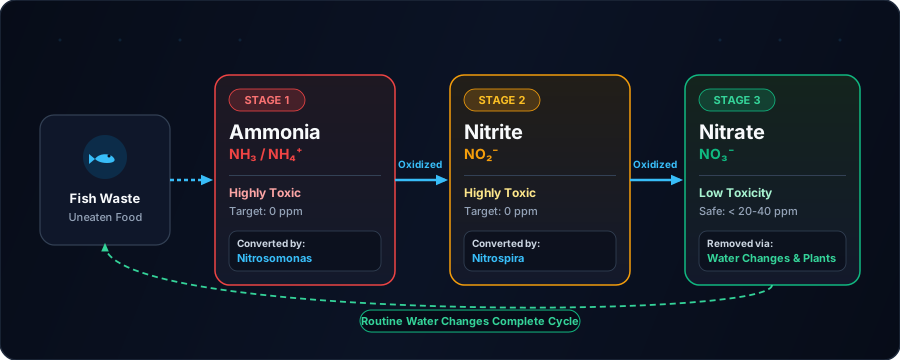
Ammonia (NH3)
Weeks 1-2: Ammonia rises and peaksAmmonia is highly toxic to fish. Even small amounts burn gills and damage organs. This is what makes uncycled tanks deadly.
Source: Fish waste, uneaten food, decaying matter
What happens: Nitrosomonas bacteria colonize your filter and begin converting ammonia.
Nitrite (NO2)
Weeks 2-4: Nitrite rises as ammonia fallsNitrite is also toxic. It prevents fish blood from carrying oxygen, causing suffocation even in well-aerated water.
Source: Converted from ammonia by Nitrosomonas bacteria
What happens: Nitrospira bacteria develop and begin converting nitrite to nitrate.
Nitrate (NO3)
Weeks 4-8: Nitrate appears, ammonia and nitrite drop to 0Nitrate is much less toxic and tolerable at moderate levels. It accumulates over time and is removed through water changes.
Source: Converted from nitrite by Nitrospira bacteria
What happens: Your cycle is complete when ammonia and nitrite read 0 and nitrate is present.
Fishless Cycling (Recommended)
The safest and most humane method. No fish are harmed because none are present during the toxic phases.
Set up your tank
Install filter, heater, substrate, and decor. Fill with dechlorinated water. Run the filter 24/7.
Add an ammonia source
Use pure ammonia (no surfactants) or fish food. Dose to 2-4 ppm ammonia. Dr. Tim's Ammonium Chloride is popular.
Test daily
Track ammonia, nitrite, and nitrate daily. You'll see ammonia spike first, then nitrite, then nitrate.
Re-dose ammonia
When ammonia drops to 0, re-dose to 2 ppm. This feeds the growing bacteria colony.
Wait for nitrite to drop
The nitrite spike is often the longest phase. Be patient. It can take 2-3 weeks to clear.
Confirm the cycle
Your tank is cycled when it can convert a full dose of ammonia (2 ppm) to 0 ammonia AND 0 nitrite within 24 hours.
Do a large water change
Do a 50-80% water change to reduce accumulated nitrate, then add fish gradually over several weeks.
Patience is key. Using bottled bacteria like Fritz Turbostart can reduce this to 1-2 weeks. Seeded filter media from an established tank can make it even faster.
Fish-In Cycling (Emergency Only)
If you already have fish in an uncycled tank (it happens, pet stores rarely mention cycling), follow these steps to keep them alive while the cycle establishes:
- Daily 25-30% water changes. This is non-negotiable. Dilutes ammonia and nitrite to survivable levels.
- Use Seachem Prime. It detoxifies ammonia and nitrite for 24-48 hours while keeping them available to bacteria.
- Add bottled bacteria daily. Fritz Turbostart or Seachem Stability. This accelerates bacteria colonization.
- Feed sparingly. Less food = less waste = less ammonia produced.
- Test parameters daily. Track progress. When ammonia and nitrite stay at 0 for a week, your cycle is established.
Maintaining Your Cycle
Do This
- Rinse filter media in old tank water only
- Keep the filter running 24/7
- Let new filter media overlap with old for 2+ weeks
- Maintain stable temperature
- Add fish gradually to avoid overwhelming bacteria
Never Do This
- Rinse filter media in tap water (chlorine kills bacteria)
- Replace all filter media at once
- Turn off the filter for extended periods
- Add many fish at once (causes a mini-cycle)
- Use medications that say "may harm biological filtration"
Troubleshooting
Ammonia won't drop
Common causes: Chlorinated water killing bacteria, filter not running, insufficient bacteria population
Fix: Use dechlorinator, ensure filter runs 24/7, add bottled bacteria (Seachem Stability, Fritz Turbostart).
Nitrite stuck high for weeks
Common causes: Nitrospira bacteria are slower to establish than Nitrosomonas
Fix: Be patient. This is normal. Ensure good water flow through filter media. Don't clean the filter.
Mini-cycle after adding fish
Common causes: Added too many fish at once, overwhelming the bacteria
Fix: Do daily 25-30% water changes. Add fish gradually, no more than 2-3 small fish per week.
Cycle crashed
Common causes: Cleaned filter in tap water (chlorine killed bacteria), medications killed bacteria, power outage
Fix: Re-dose with bottled bacteria. Do daily water changes to keep ammonia below 0.25 ppm while bacteria recover.
Frequently Asked Questions
Can I speed up the nitrogen cycle?
Yes. Use filter media or gravel from an established tank. Bottled bacteria products (Fritz Turbostart 700 is highly regarded) can reduce cycling time to 1-2 weeks. Higher temperatures (80-84°F) also speed up bacterial growth.
Do I need to cycle if I'm using live plants?
Yes, but plants help. They absorb ammonia directly, reducing toxicity during cycling. Heavily planted tanks may appear to cycle faster, but you still need beneficial bacteria for long-term stability.
What is New Tank Syndrome?
New Tank Syndrome is when fish die in a new, uncycled aquarium because ammonia and nitrite build to toxic levels. The tank lacks the beneficial bacteria needed to process waste. This is prevented by cycling before adding fish.
Can I cycle with just fish food?
Yes. Drop a pinch of fish food in daily. As it decays, it produces ammonia. However, pure ammonia is more controllable. Fish food decomposition is unpredictable and messy. Use pure ammonia if available.
Track Your Cycle with MyAquaLog
Log ammonia, nitrite, and nitrate daily. See charts showing your cycle progress. Know exactly when your tank is safe for fish.
Start Tracking Free